

Most people treat Vientiane like a transit lounge with better coffee. You land, stamp the visa, sleep once, then flee toward the prettier parts of Laos. Fair — the city doesn’t perform for you. It just sits there on the Mekong, low and dusty and unbothered, moving at the speed of a tuk-tuk that has nowhere particular to be.
But if you stay — really stay — something strange happens. Time loosens. The heat softens the edges of your plans. You find yourself lost in translation in the best possible way: not understanding half the conversations around you, yet somehow understanding the rhythm. It’s the kind of place you’d want to linger in longer than the schedule allows, just watching people eat, drink, and exist without urgency. A genuine pause in the universe.
Here’s how three days can unfold when you let the city set the pace.
Day 1 — Arrival, carbs, and the slow surrender
You step out of the airport into that thick, forgiving heat — hopefully with your visa sorted in advance so you’re not queuing at immigration. Drop your bags first so you aren’t hauling luggage through the humidity. If you’re watching the budget, SYRI Guesthouse keeps things clean, central, and cheap. If you want to splurge on something with actual character, Lao Poet Hotel delivers modern design with a subtle nod to 1930s Vientiane.
First order of business is the food that actually holds this city together. Find a Khao Jee Pâté — the Lao baguette sandwich done right, from Ong Dung, La’Paté, or any street cart that looks busy. Crusty bread, rich pâté, meats, pickled vegetables, chili, herbs — colonial ghost food perfected by Lao hands.
Before tracking down lunch, walk off the bread between two historical heavyweights sitting right across from each other on Setthathirath Road: Wat Si Saket and Wat Ho Phra Keo.
Wat Si Saket is the oldest surviving temple in Vientiane, famous for its cloister walls lined with thousands of tiny silver and terracotta Buddha images. Right across the street, Wat Ho Phra Keo once housed the Emerald Buddha before Siamese forces carried it off to Bangkok. Rebuilt as a museum, its elevated terrace and carved teak details present a completely different, grander architectural statement.
Walk just south of the temples near Rue That Khao to Phapho Noodle Shop for a bowl of Khao Piak Sen. This is the downtown spot local forum threads continuously single out for a reason: thick, house-made tapioca-rice noodles served in a rich chicken broth, topped with their signature pork-fat chili oil. Show up before 1:00 PM or they routinely run out of the thick-cut noodles. This is not tourist food. This is what people eat when they need to feel human again.

Head back to the hotel, blast the AC, and take a proper midday nap. Vientiane shuts down under the afternoon sun for a reason.
As the afternoon softens, drift down to the beach at Mekong Escapes. Cheap entry, clean sand, grilled skewers, cold drinks, ridiculous photo frames, and the river sliding past like it has all the time in the world.

Later, eat proper Thai-Lao food at Tummour (river views) or Hangout (more local, less postcard). End the night at Sticky Fingers with a Tom Yum Martini — spicy, citrusy, dangerous. You’ll go to bed full and slightly untethered, already forgetting whatever schedule you thought you had.

Day 2 — Hangover diplomacy, movement, Chinese rabbit holes, and a proper reset
Morning arrives gently or not at all. The Tom Yum Martini is still negotiating terms. Cure it the local way: strong Lao coffee (at Le Trio Coffee) and, if the stomach allows, another bowl of Khao Piak Sen. No rush. Vientiane does not reward rushing.
When the fog lifts, move. Do what the locals do — walk or jog the Mekong riverfront at dawn when the air is cool and the city is still stretching, or stroll it at dusk when families come out and the light turns gold. The river has a way of resetting your internal clock.
In the softer hours, visit Pha That Luang. Golden, quiet, important. Dress modestly. Sit longer than you planned.

Afterwards, find a simple beershop in the neighborhood — plastic chairs, ice-cold Beerlao in big bottles, no playlist, no performance. Just people talking, or not talking.
Later, let yourself get properly lost in Vientiane’s Chinatown — the Chinese commercial streets around the older merchant pockets and the newer trade hubs. It hums with a different energy — practical, loud, full of wholesale goods and neon. Follow your nose into an obscure Chinese restaurant with no English menu and questionable lighting. Order whatever the table next to you is having. Halfway through the meal you will find yourself wondering, with a mixture of curiosity and mild alarm, whether you are currently eating an endangered species. Smile, keep chewing, and accept that some questions are better left unanswered.
As the day softens, book a legitimate traditional Lao massage. Skip anything with neon signs and lingering eye contact. Go instead to Wat Sok Pa Luang (the temple herbal sauna and massage) or a clean, well-regarded place like Oasis on François Ngin. You’ll change into loose cotton pajamas, lie on a low mattress, and receive the real thing: rhythmic pressure, stretching, and quiet focus. No extras, no awkward negotiations — just skilled hands working out the travel knots while the city continues its unhurried business outside. It feels like the pause inside the pause.
Day 3 — Weight, light, and the quiet exit
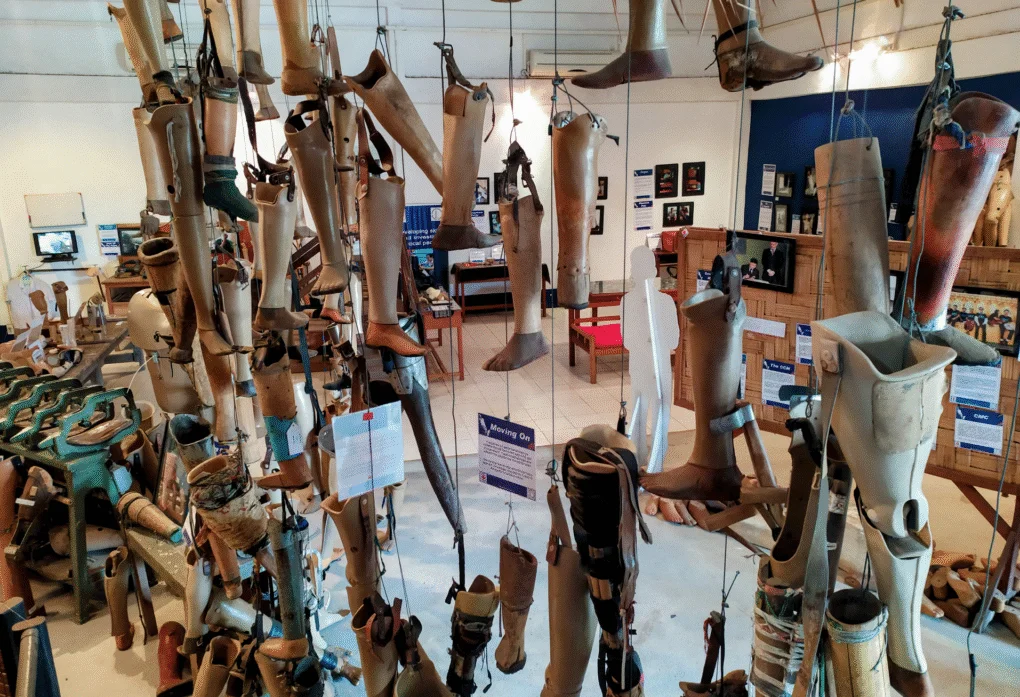
By now the city has worked on you. You’ve eaten its daily bread and noodles, drunk its beer, moved to its rhythm, questioned a Chinese menu, and been properly realigned by a masseuse who had no interest in anything below the belt. Time for the thing that keeps the pleasure from feeling empty: the COPE Visitor Centre. Free, quiet, and necessary. The ongoing story of unexploded ordnance, the prosthetics, the human cost that still shapes lives here. Sit with it. Watch a short film if they’re screening one. Leave a donation. The contrast — the easy river days against this heavier truth — is part of what makes the place real.
Spend the rest of the day gently. One more coffee. One more walk along the Mekong. Maybe a final Beerlao while the sun drops behind the Thai side of the river. You don’t need to fill every hour. Vientiane teaches you that empty hours can be the point.
When you finally leave, the city won’t feel like a stopover anymore. It will feel like a pause you almost missed — a soft, dusty, river-lit interval where the universe briefly stopped asking you to hurry. And that, somehow, is unforgettable.

Landing in Vientiane? Get your Laos eSIM before you fly so you can map, message, and book Beerlao runs the moment you touch down — QR delivery, Unitel network, no roaming fees. For everything else — visas, apps, payments — see our Laos travel digital checklist.
