Is There Internet in Pakse? The Complete Wi-Fi & Mobile Data Guide (2026)
Type “is there internet in Pakse” into Google and you’ll mostly find generic “SIM cards in Laos” listicles that never actually answer the question for this specific town. Here’s the direct answer, backed by what recent travelers, hotel guests and residents have actually reported — not a marketing summary.
Short version: yes, Pakse is well connected. 4G mobile data is generally reliable in town, Unitel is the safest single network if your trip continues into southern Laos, and the real weak point isn’t a lack of internet — it’s inconsistent hotel Wi-Fi from room to room. The connectivity story only gets genuinely patchy once you leave Pakse for the Bolaven Plateau, the Wat Phou/Champasak corridor, or the 4,000 Islands.
This guide goes deep on all of it: real 2026 speed data, a carrier-by-carrier breakdown, named hotel Wi-Fi reviews (good and bad), the café scene for remote work, airport SIM availability, physical SIM vs. eSIM, and a location-by-location table for everywhere travelers actually go from Pakse.
The direct answer
Pakse, the capital of Champasak Province and the main gateway to southern Laos, is one of the better-connected towns in the country. That's not a promotional claim — it's the consistent pattern across Reddit threads, hotel review sites, and 2026 connectivity assessments alike: infrastructure exists, mobile data works, and fixed fiber broadband is genuinely available for residents.
The useful distinction, and the one almost no other article makes clearly, is this:
Pakse itself is well connected. The connectivity problem starts when you leave Pakse — for the Bolaven Plateau, Wat Phou and the Champasak corridor, or the 4,000 Islands.
For ordinary travel — Google Maps, WhatsApp or Messenger, social media, hotel and tour bookings, photo uploads, even Netflix — mobile data in Pakse should be a non-issue. Treat hotel or café Wi-Fi as a convenience layered on top of that, not your primary connection.
Mobile coverage: what actually works
The clearest, most recent signal comes directly from people who've used the networks in Pakse recently, not marketing copy.
A December 2025 Reddit comment on a Pakse-specific thread put it plainly:
"Mobile internet is actually pretty good."
The same commenter named both Unitel and Lao Telecom as working fine in town, at speeds acceptable for work, video, and normal daily use. That's a meaningfully more positive read than the older "Laos internet is slow" narrative still floating around from a decade ago — and it matches a broader pattern: recent traveler comments trend toward "stable," "works for Netflix," and "good enough," while older reports (some from 2011-2014) described frequent drops and sluggish 3G. The underlying infrastructure has changed substantially since then; treat pre-2020 travel reports about Laos internet as historical color, not current fact.
A separate, earlier Reddit thread from a traveler working remotely between Pakse and Don Det reported:
"I found Unitel good enough to watch Netflix on Don Det and Pakse,"
and, more usefully for this guide's central argument:
"[Wi-Fi] service is less reliable than phone data."
That's the single most load-bearing finding in the research behind this guide: for a dependable baseline connection in Pakse, mobile data consistently outperforms hotel Wi-Fi in traveler reports. Wi-Fi is common and convenient, but it shouldn't be your Plan A.
A July 2025 Reddit discussion specifically about living in Pakse added a resident's perspective that's worth including because it complicates the simple "good or bad" framing usefully:
"Both are pretty similar in my experience specially in pakse,"
one respondent said of Unitel versus Lao Telecom, adding that outside the city, one network or the other can pull ahead depending on exact location. A more critical resident comment named the real weakness precisely:
"If the internet goes down or fiber line breaks, it takes an act of god to get them to fix it" —
but the same person said mobile data is fine for short stays. In other words: the infrastructure and the mobile networks are genuinely solid; slow fault resolution on fixed-line residential service is the actual pain point, and it's a resident's problem, not a tourist's.
Which carrier to choose
There's a remarkably consistent pattern across every source we checked — traveler forums, hotel-adjacent connectivity guides, and Unitel and Lao Telecom's own published information.
| Area | Recommended network | What to expect |
|---|---|---|
| Pakse centre, riverside, markets, bus station | Unitel or Lao Telecom | Solid 4G, either works |
| Pakse Airport & hotels/cafés | Unitel or Lao Telecom | Reliable, convenient |
| Bolaven Plateau (Paksong, Tad Lo, the loop roads) | Unitel | More patchy; Unitel holds up best |
| Champasak / Wat Phou corridor | Unitel | Gradually weaker outside populated stretches |
| 4,000 Islands (Don Det, Don Khon) | Unitel | Usable, but noticeably slower than Pakse |
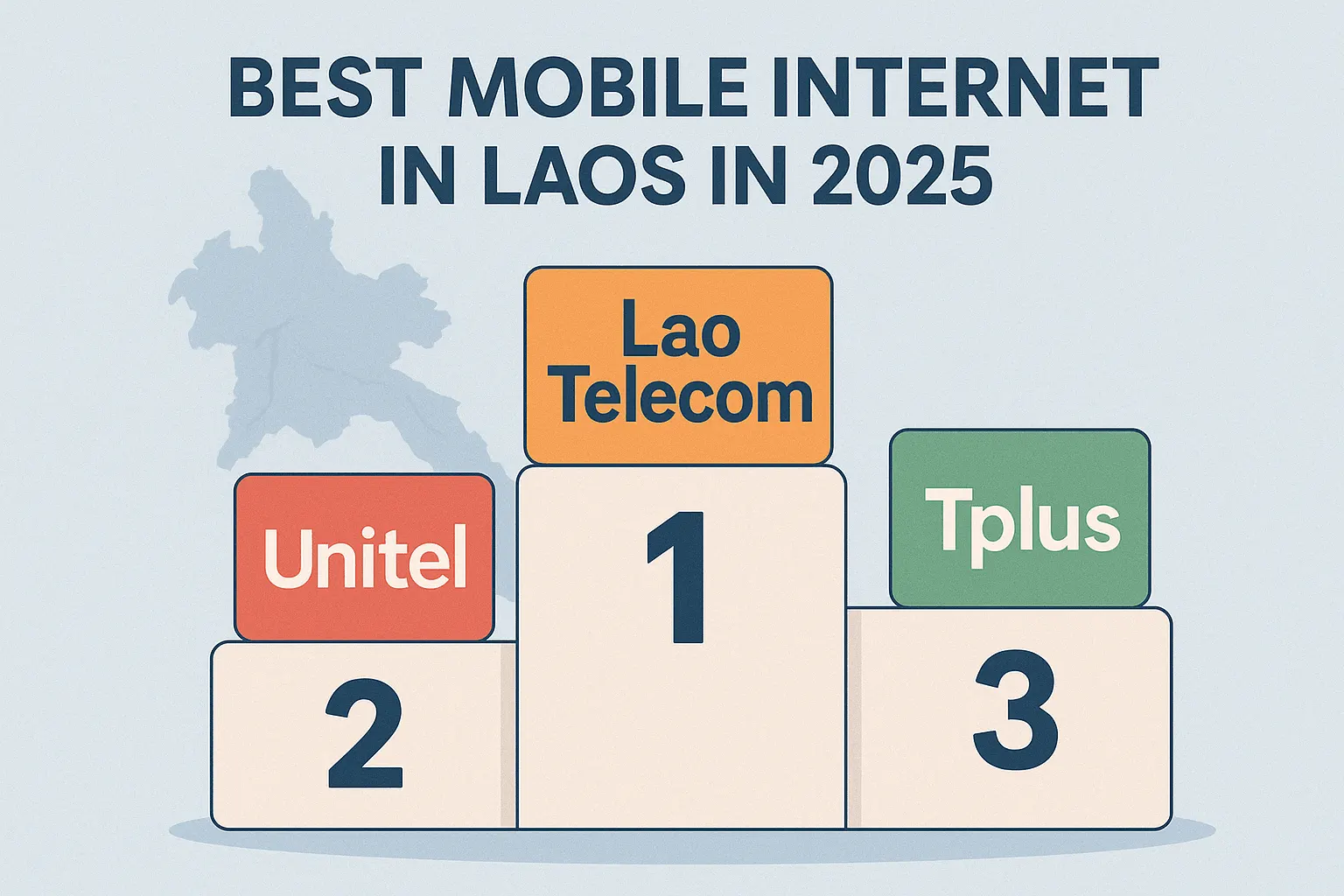
Unitel is the network named most consistently as the strongest all-round choice the moment your trip extends beyond Pakse itself — the Bolaven Plateau, the road to Champasak and Wat Phou, and onward to the 4,000 Islands. Lao Telecom is a fully credible, comparable option inside Pakse town, and residents describe the two as "pretty similar" there — but Unitel is the more frequently recommended pick once you're on rural roads. ETL shows up in provider guides as present in Pakse and other southern urban markets, but with a materially smaller footprint once you leave town; it's a reasonable option if you're staying entirely in Pakse, but not the safer bet for a wider southern-Laos itinerary. We found no working eSIM product from ETL or from TPlus (Star Telecom, formerly Beeline) at the time of writing — both appear to be physical-SIM-only for visitors.
If your itinerary is Pakse plus the Bolaven Plateau, Champasak, or the 4,000 Islands — which describes most travelers passing through — Unitel is the one network that gives you the best odds the whole way round.
Real 2026 speed data
A 2026 community-aggregated connectivity assessment for Pakse (measurements gathered in May 2026) reported the following ranges. Treat these as indicative real-world figures from crowd-sourced testing, not an operator-verified benchmark — we're phrasing this deliberately as "recent community measurements found," not "Pakse averages X Mbps."
| Location | Connection | Reported speed |
|---|---|---|
| Pakse centre | Unitel 4G | ~25-35 Mbps |
| Bolaven Plateau main roads | 3G/4G | ~10-25 Mbps |
| Tad Fane waterfall | 4G | ~15-20 Mbps |
| Don Det (4,000 Islands) | Unitel 4G | ~5-15 Mbps |
| Don Khon (4,000 Islands) | 4G | ~5-10 Mbps |
For context, a separate national-level estimate puts average mobile speed across Laos at roughly 50 Mbps and fixed broadband around 40 Mbps (Global Speed Index-based). We wouldn't apply that national figure to Pakse specifically — it's useful only as a reminder that Laos as a whole is no longer the "offline" destination it's sometimes still assumed to be.
What these numbers mean practically: 25-35 Mbps on Unitel 4G in central Pakse is comfortably enough for maps, messaging, social media, video calls, and streaming. The numbers only start to matter once you're doing something bandwidth-heavy (large uploads, multi-person video calls, hotspotting several devices) or once you've left town for the plateau or the islands, where the same activities get noticeably less comfortable.
Hotel Wi-Fi: the honest picture
This is the part of the connectivity story that's genuinely inconsistent in Pakse — and it's property-specific, not town-wide. Don't take "free Wi-Fi" on a booking listing as a promise of a good connection in your actual room.
Pakse Hotel & Restaurant is a useful case study because it has a long review history: Booking.com currently shows an 8.3/10 Wi-Fi score across 669 reviews, and some Tripadvisor guests describe good speed and connectivity. But other guests report the opposite in the same property — one Tripadvisor review says staff told them the internet was "bad everywhere in Pakse" when their room's Wi-Fi didn't work (the guest then found a nearby hotel where it worked fine), and January/December 2025 reviews on Agoda separately describe a room with no usable Wi-Fi and thick walls weakening the signal in parts of another room. The likely explanation isn't the hotel's internet connection — it's in-building Wi-Fi coverage, which is a completely different problem than "no internet in Pakse."
Several other named, recently-reviewed properties show the same pattern of a good hotel paired with inconsistent Wi-Fi:
- Champasak Grand Hotel — a March 2026 guest called the Wi-Fi "very bad connection" and said it made laptop work difficult, while rating everything else about the stay well.
- Lankham Hotel — a March 2026 review described the Wi-Fi as "very mediocre"; a separate February 2026 review liked the location and price but specifically flagged the Wi-Fi as needing improvement.
- KK Hotel Pakse — a March 2026 guest liked the hotel overall but said the internet connection "isn't very reliable and sometimes disconnects."
- Soubandith Hotel — a January 2026 review praised the room and location but named "the poor internet connection" as the main downside.
- Sabaidee Valley Resort (outside central Pakse) — a 2025 review reported the connection was "quite slow," a useful reminder that moving away from the urban centre increases the odds of a weaker signal.
It's not all mixed news. Anou Hostel currently holds a 9.0/10 Wi-Fi score on Booking across more than 1,100 reviews — stronger than Pakse Hotel's own score — and Le Jardin Hotel de Pakse advertises high-speed Wi-Fi throughout the property, including all common areas.
The honest summary, and the one this article is built around: hotel Wi-Fi in Pakse is unpredictable, not uniformly bad. Some properties genuinely deliver; others have weak in-room coverage or unstable service, and recent 2026 reviews show both extremes at once. Before you count on a hotel's Wi-Fi for anything important, ask the property directly whether it works inside your specific room, not just "does the hotel have Wi-Fi."
Cafés with reliable Wi-Fi
Pakse has a genuinely useful café scene for anyone who wants a backup to hotel Wi-Fi or a place to get work done.
- Café Sinouk — a well-established central Pakse stop, listed with free Wi-Fi by Wikivoyage and by regional travel guides.
- Vida Bakery Café — air-conditioned, comfortable seating, and specifically recommended for working on a laptop; one of the stronger picks if you need a few focused hours online.
- Amor Fati Café — a 2024 customer review specifically confirmed "wifi working well," and the café is listed with free Wi-Fi.
- Samlee's Garden — an active restaurant/guesthouse combination with free Wi-Fi and a solid tourist-base reputation.
There's no dedicated coworking space in Pakse as of this writing — multiple current sources agree on that — so cafés are the practical stand-in. 124 Thaluang Coffee also comes up as a working option in local digital-nomad guides, alongside Vida.
Can you work remotely from Pakse?
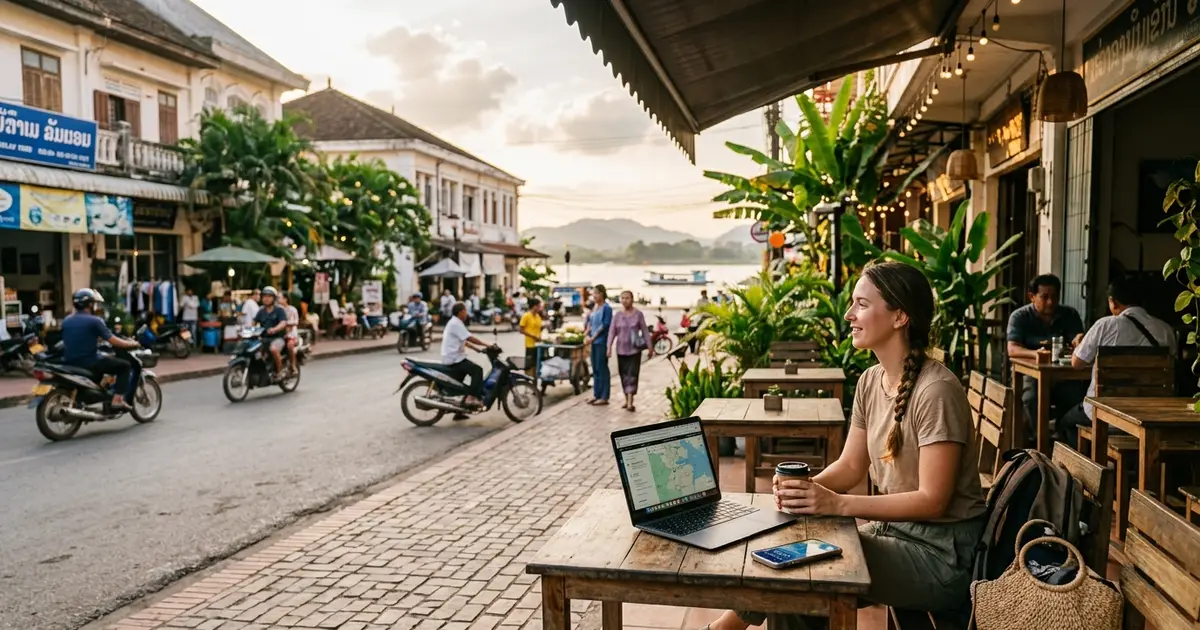
Yes — with a setup built around mobile data rather than hotel Wi-Fi. The pattern across every source is consistent: normal browsing, messaging, video calls, and streaming are generally fine on Unitel 4G in Pakse; heavier professional work (continuous video conferencing, large uploads, cloud administration under deadline) is possible but should never depend entirely on a hotel's advertised Wi-Fi, given how inconsistent it's shown to be property to property.
A practical remote-work setup for Pakse:
- Get a Unitel eSIM or SIM before you need it working — not after your hotel Wi-Fi disappoints you on day one.
- Treat cafés (Vida Bakery, Café Sinouk) as your fallback workspace, not the hotel room.
- If a specific video call or deadline genuinely matters, hotspot from your phone rather than trust the hotel network — traveler reports consistently rate mobile data above Wi-Fi for reliability in Pakse.
- Ask any hotel directly, before booking, whether Wi-Fi is confirmed working in-room and whether there's backup power for outages — not just whether Wi-Fi exists as an amenity.
Buying a SIM at Pakse Airport
Several current sources describe limited SIM availability at Pakse International Airport (PKZ) compared with Vientiane's larger international airport. A Unitel counter is reported to operate around flight arrival times, and a Lao Telecom presence may appear during peak periods — but ETL and TPlus counters are rarely present, and overall availability is described as noticeably less dependable than at Laos's bigger airports.
We'd phrase the practical guidance carefully rather than promise a queue-free counter: a Unitel SIM counter may be available at Pakse Airport around flight arrivals, but don't count on it being staffed every time. If you want guaranteed connectivity the moment you land — no counter search, no queue, no dependency on flight-timing luck — install an eSIM before you fly instead.
Physical SIM vs. eSIM
Both work in Pakse. The honest tradeoffs:
A physical SIM at an airport counter or in-town shop requires passport ID and standard KYC registration, and can beat a pre-bought eSIM on raw price per GB since there's no reseller margin — but only if a counter is actually staffed when you land, and only if you're comfortable with a bit of arrival-day admin.
An eSIM installed before you fly removes that dependency entirely: the QR code and registration are handled in advance, so you land already connected. Recent verified reviews of Unitel-based eSIMs describe stable, fast connections around Pakse, Tad Tayik Sua and Tad Fane, with one reviewer noting the connection was faster than their hotel's internet, switching cleanly between 4G and 5G. That said, eSIM reviews aren't universally glowing — one verified customer reported "extremely poor signal quality and unstable connectivity in several areas." The lesson isn't that eSIMs are unreliable; it's that an eSIM's real-world performance depends entirely on the physical network underneath it, not the eSIM brand. A roaming eSIM from a global marketplace and a genuine local Unitel line can produce very different results in the same town, because they're not actually the same network access.
That's the single most important thing to check before buying any eSIM for Laos: which physical network does it actually put you on? We cover this in full, network by network, in our companion guide, Best eSIM for Laos 2026: Which Network Actually Covers Where You're Going — it's the piece to read if you're comparing providers rather than deciding SIM-vs-eSIM.
Our own Laos eSIM is a genuine local Unitel subscriber profile — not a roaming resell — installed by email before you fly, from $6.90 for 10 days. It runs on the same Unitel network this entire guide points to as the safest choice for Pakse and the wider south.
Coverage beyond Pakse
This is where the connectivity story genuinely changes, and where most generic "Laos SIM card" articles stop being useful.
| Destination from Pakse | What to expect |
|---|---|
| Bolaven Plateau loop (Paksong, Tad Lo, the waterfalls) | Good in the towns; patchy on the back roads between waterfalls and in forested valleys. Unitel holds up best. See our Bolaven Plateau connectivity guide for the full loop breakdown. |
| Champasak / Wat Phou corridor | Usable but progressively weaker outside populated stretches; Unitel is the steadier option. |
| 4,000 Islands (Don Det, Don Khon) | Workable but meaningfully slower than Pakse — roughly 5-15 Mbps on Don Det's main village, less on Don Khon, and guesthouse Wi-Fi there can be as low as 1-5 Mbps. Get your SIM or eSIM sorted in Pakse, not after you arrive on the islands. Full detail in our 4,000 Islands connectivity guide. |
| Remote areas generally | Assume weaker or no coverage the further you get from a provincial town, regardless of network. No provider — us included — can honestly promise otherwise. |
Before leaving Pakse for any of these routes: download offline Google Maps (or Maps.me) for the whole area, pin your waterfalls or island guesthouse in advance, and screenshot booking confirmations. That turns patchy rural coverage from a real problem into a non-issue.
Wi-Fi vs. mobile data, side by side
| Hotel Wi-Fi | Mobile data | |
|---|---|---|
| Pakse centre | Variable — some properties excellent, others weak in-room | Generally good |
| Reliability | Property-dependent | Generally better, per repeated traveler reports |
| Bolaven Plateau | Poor/mostly irrelevant outside towns | Patchy but useful, Unitel best |
| 4,000 Islands | Often slow (as low as 1-5 Mbps reported) | Better than hotel Wi-Fi, still slower than Pakse |
| Setup | Automatic, but quality is a lottery | Requires a SIM/eSIM, but predictable once set up |
| Cost | Usually included in the room | Very inexpensive locally (see below) |
| Best used as | A bonus, when it happens to be good | Your primary connection |
Claims we won't make
Because this guide draws on real traveler and guest reports rather than a single official source, it's worth being explicit about the claims the evidence doesn't support — several competing articles make exactly these overreaches:
- ❌ "Pakse has the fastest internet in Laos."
- ❌ "Unitel always has the fastest connection."
- ❌ "Pakse has nationwide 5G." (Unitel advertises province-wide 5G; independent traveler reports in Pakse still describe a primarily 4G experience.)
- ❌ "Every Pakse hotel has reliable Wi-Fi." (Several named, recently-reviewed hotels explicitly contradict this.)
- ❌ "There's no internet on the Bolaven Plateau" or "in the 4,000 Islands." (Both have usable coverage — it's slower and patchier, not absent.)
- ❌ "Pakse Wi-Fi is bad." (It's inconsistent, not universally bad — see Anou Hostel's 9.0/10 score.)
- ❌ Any specific "Pakse averages X Mbps" claim stated as an official benchmark rather than a community-sourced estimate.
The practical setup
Based on everything above, here's what we'd actually do:
- Short trip, want it working the moment you land: install a Unitel-based eSIM before you fly. Our Laos eSIM plans start at $6.90 for 10 days.
- Longer stay, or visiting Pakse plus the Bolaven Plateau and the 4,000 Islands: the same Unitel eSIM covers the whole route, or top up a local Unitel line once you're here — see our Unitel data package prices and USSD codes for the current lineup once you've landed.
- Arriving via Thailand or planning both countries: check our Laos + Thailand eSIM guide if your route continues that way.
- Working remotely: mobile data as primary, a known-good café (Vida Bakery, Café Sinouk) as backup workspace, hotel Wi-Fi treated as a bonus rather than infrastructure you depend on.
- Heading beyond Pakse: download offline maps before you leave town, regardless of which network you're on.
Pakse earns its reputation as one of southern Laos's better-connected bases — the internet is there, it's just a question of knowing which layer of it (mobile vs. hotel Wi-Fi) to actually rely on, and being realistic about how far that coverage travels once you head for the plateau, Champasak, or the islands.
Frequently asked questions
Is there internet in Pakse? +
Yes. Pakse has good, widely available 4G mobile coverage and Wi-Fi in most hotels, guesthouses, cafés and restaurants. It's one of the better-connected towns in southern Laos — the real variability is in hotel Wi-Fi quality from room to room, not in whether the town has internet at all.
Is Wi-Fi good in Pakse? +
It depends entirely on the property. Some hotels score very highly for Wi-Fi in recent guest reviews (Anou Hostel: 9.0/10 on Booking across 1,100+ reviews), while others get specific 2026 complaints about weak or unstable connections in certain rooms. Advertised free Wi-Fi is nearly universal; consistent in-room signal strength is not.
Is mobile data better than Wi-Fi in Pakse? +
For reliability, generally yes. Multiple traveler reports independently describe mobile data (specifically Unitel) as more dependable than hotel Wi-Fi in Pakse, and recommend using it as the primary connection rather than a backup.
Which network is best in Pakse? +
Unitel is the safest single choice, especially if your trip continues beyond Pakse to the Bolaven Plateau, Champasak, or the 4,000 Islands. Lao Telecom is a solid, comparable alternative inside Pakse itself, but traveler reports consistently favor Unitel once you're outside town.
Does Unitel work in Pakse? +
Yes, reliably. It's the most frequently recommended network across traveler forums, hotel-adjacent reviews and connectivity guides for both Pakse town and the wider Champasak region.
Is 4G available in Pakse? +
Yes, widely. 4G is the connection type most travelers should plan around in Pakse. Community-aggregated measurements from 2026 put central Pakse Unitel 4G speeds at roughly 25-35 Mbps — treat that as an indicative real-world range, not an official benchmark.
Does 5G work in Pakse? +
Unitel advertises 5G coverage across all 18 provinces of Laos, but independent, Pakse-specific traveler reports still primarily describe a 4G experience in town. Actual 5G availability can depend on location and handset. Plan around 4G and treat any 5G connection as a bonus.
Can I buy a SIM card at Pakse International Airport? +
Sometimes. A Unitel counter is reported to operate around flight arrival times, and Lao Telecom may appear during peak periods, but availability is noticeably less reliable than at Vientiane's international airport. If guaranteed connectivity from the moment you land matters, install an eSIM before you fly instead.
Is there internet on the Bolaven Plateau? +
Yes in Pakse and the larger plateau towns (Paksong, Tad Lo), but coverage becomes patchy on the back roads between waterfalls and in forested valleys. Unitel is the more frequently recommended network for the loop. Download offline maps before you leave Pakse.
Is there mobile coverage on the road to the 4,000 Islands? +
Generally yes along the main route, thinning out in rural stretches. Once on the islands, expect noticeably slower speeds than in Pakse — 2026 community data suggests roughly 5-15 Mbps on Don Det's main village on Unitel 4G, and as little as 1-5 Mbps on guesthouse Wi-Fi there.
How much mobile data do I need for a Pakse trip? +
For a typical short stay covering maps, messaging, social media and normal browsing, 4-7 GB is a reasonable starting allowance. Increase that if you'll be hotspotting a laptop, making frequent video calls, or streaming regularly.
Can I work remotely from Pakse? +
Yes, with the right setup. Treat mobile data as your primary connection and hotel Wi-Fi as a convenience rather than something to build a work schedule around. For anything deadline-critical — long video calls, large uploads, cloud administration — test your accommodation's Wi-Fi first and keep a mobile hotspot as backup.
Need mobile data sorted for your Laos trip? Our Laos eSIM runs on the local Unitel network, from $6.90.