Laos Is Building an AI Strategy: From LaoAI to Green AI Data Centres (2026)
The short version: over about sixteen months, Laos has moved from AI policy discussions to a draft National AI Strategy 2026–2035 — approved in principle by the Cabinet in September 2026 and still under revision — alongside a Lao-language AI tool (LaoAI), an AI layer inside government (G-Chat v2), a UNESCO-backed governance framework, a proposed green-compute and data-centre programme including the Savan Nexus campus in Savannakhet, and a growing set of international partnerships. This guide sets out the sequence of events, explains what each step does for Laos, and uses a light analytical lens to show how the pieces fit together. It is written to be useful to anyone trying to understand the country's direction — not to score it.
Last updated: 3 October 2026. The full National AI Strategy text is not yet public; this article tracks what has been officially announced and will be revised as the strategy is finalised.
The maturity level matters. Read throughout, this is a draft strategy (agreed in principle, under revision), an early public-sector deployment (LaoAI in G-Chat v2), and feasibility/pilot infrastructure (data centres, green AI, SEZs) — not completed national AI capability or an operating green data-centre estate. We keep those categories separate from binding policy and from built infrastructure.
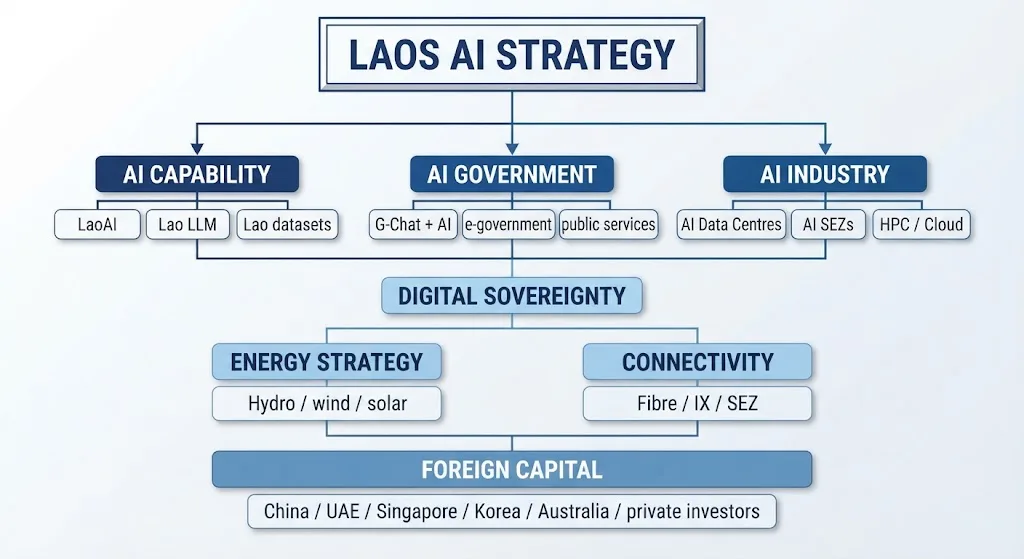
Laos' AI strategy in one picture
Laos is not trying to build the next OpenAI. The strategy that has emerged is more practical and, arguably, more achievable: build Lao-language AI capability, put AI inside government, and attract AI-ready infrastructure and investment — then connect all of it to two of the country's existing strengths, clean energy and regional connectivity. The graphic above shows the shape: three workstreams — AI capability, government and industry — feeding into the goal labelled "digital sovereignty", supported by energy and connectivity, and financed through foreign partnerships.
Read that way, the announcements look less like scattered news and more like layers of one emerging programme — though that is an interpretation, not evidence of a single funded implementation plan.
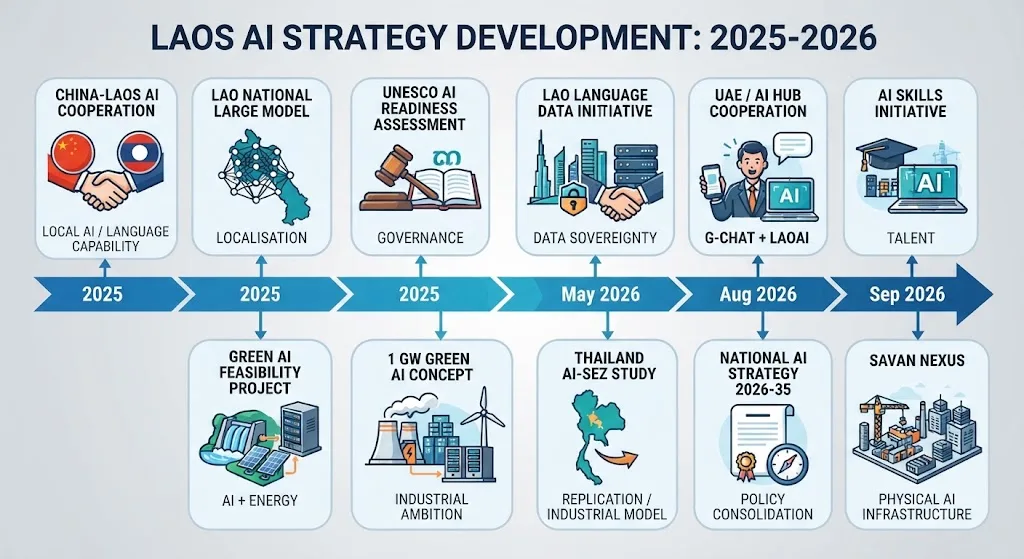
How Laos got here: the sequence, 2025–2026
The clearest way to understand the strategy is chronologically. The order matters: Laos built capability first, then deployed it in government, then began positioning itself internationally, and only then moved to industrial-scale infrastructure ambitions.
| Date | Development | Type · source | What it tells us |
|---|---|---|---|
| 23 Feb 2025 | China–Laos AI Innovation Cooperation Centre agreed with China's Guangxi region (SASAC) | Official · KPL / SASAC | Establishes a technology and language channel; described in official material as a first-of-its-kind China–ASEAN AI cooperation platform |
| 2–6 Apr 2025 | Lao Digital Week 2025 foregrounds AI, cloud and digital skills | Official · KPL | AI is placed inside the wider digital-government, digital-economy and digital-society agenda |
| 30 May / 3 Jun 2025 | National Data Center × Silicon Tech Park MoU for green-energy-powered AI infrastructure; AI Innovation Centre pilot; AI SEZ study over 150 hectares (Vientiane) | MoU / study · KPL | An early publicly announced, site-linked AI-infrastructure proposal — explicitly a feasibility study |
| 16–17 Jun 2025 | MTC Responsible AI Workshop | Official · KPL | Early governance and capacity building across agencies |
| Sep 2025 | China–Laos AI cooperation centre launched (SASAC); a Lao National Large Model reported (ISEAS) | Official · SASAC / Research · ISEAS | Local-language model work, including Lao–Chinese–English translation |
| Oct 2025 | ASEAN AI Governance Roundtable (AI Singapore, MTC, ARIST) in Vientiane | Research · NUS/AI Singapore | The clearest public outline of the draft strategy — its pillars and priority sectors |
| Oct 2025 | Lao National Large Language Model announced (ALO Technology + China–Laos Information Communication Centre) | Media · The Star | A Lao-language model-development initiative is publicly announced; target applications include agriculture, education, health, tourism and government |
| Nov 2025 | LaoAI presented as a national AI system and a gift for the 50th anniversary of the Lao PDR; LaoAI app released | Official · MPT (app: App Store) | AI moves from concept to an actual product for the public |
| Nov 2025 | A Lao delegation led by a Deputy Prime Minister visits the UAE (G42, Kaspersky, Yanggo Group, Abu Dhabi Global Market) | Official · Invest Laos | Laos starts presenting "clean energy → data centres → AI" to international investors |
| 25 Nov 2025 | Vietnam–Laos dialogue on cloud, data centres, HPC, AI and skills | Official · KPL | A regional cooperation channel alongside the China and UAE tracks |
| 4–5 Dec 2025 | Australia-supported workshop on high-quality Lao-language data for AI | Official · KPL | Language data is recognised as a strategic national asset |
| 27–30 Jan 2026 | UNESCO AI Readiness Assessment (RAM) findings launched | Research · UNESCO | An independent baseline that the National AI Strategy draws on |
| 30 Jan 2026 | Prime Minister sets 2026 as a decisive year for digital transformation and directs establishment of an AI Data Centre | Media · The Star | Explicit policy intent for national AI infrastructure — location, capacity, financing and timing not yet set |
| 3 / 10 Feb 2026 | MTC × Menas Capital (UAE) MoU toward an ASEAN Digital and AI Hub; Ministry of Finance × Kaspersky MoU on cybersecurity and digital finance | MoU / study · KPL | The UAE investment track and a security/governance track |
| 13 Feb 2026 | National Health AI Platform feasibility MoU with Chinese partners | MoU / study · The Star | Health becomes the first named sectoral deployment target |
| 17 Mar 2026 | MoU for an AI-powered green-aluminium eco-industrial park (Oudomxay) | MoU / study · KPL | AI incorporated into a broader industrial and green-energy project |
| 6–7 Apr 2026 | G-Chat v2 + LaoAI launched for government use | Official · KPL | The clearest early state-AI deployment: summarisation, drafting, translation, regulatory knowledge |
| May 2026 | MTC studies Thailand's AI-SEZ model; describes a proposed ~1 GW "Lao Green AI Data Center" | Official · MTC | Industrial-scale ambition; feasibility work reported since May 2025 |
| 2 Jun 2026 | Consultations on China's invitation to join the proposed World AI Cooperation Organisation (WAICO) (MTC) | Official · KPL / MTC | Laos positions itself within international AI governance |
| Jun 2026 | Envision Energy and IES explore an integrated renewable-energy system (wind, solar, storage, AI-enabled energy management) | Partner · Impact Electrons | The energy side of the green-compute story |
| Jul 2026 | MTC publicly links the national AI strategy, telecom infrastructure and LaoAI | Official · MTC | AI is understood as an infrastructure stack, not just software |
| Aug 2026 | Invest-in-Laos platform partners with AIDC Tech (AI, OCR, centralised investment databases); Lao AI Skills Dialogue 2026; the 2026–2030 investment agenda names data centres and AI as priority fields | Official · Invest Laos / MPT (agenda: The Star) | AI enters the investment bureaucracy, the skills agenda and the national investment plan |
| 22–24 Sep 2026 | Cabinet approves in principle the National AI Strategy 2026–2035 (with the satellite strategy), and directs revisions (Vientiane Times; KPL) | Official · Asia News Network / Vientiane Times / KPL | The policy milestone — approval followed by refinement; the final text is not yet published |
| 25 Sep 2026 | Savan Nexus AI & Digital Campus MoU (reported proposed specifications — Savan Park Zone C, Savannakhet; ~20 ha; 2 MW initial; LNCCI) | MoU / study · Vientiane Times / LNCCI | A publicly identified, site-specific southern AI-infrastructure proposal; the signing was chaired by senior Savannakhet provincial and technology-ministry officials, and attended by infrastructure vendors Comin Asia and Nokia (Comin Asia) |
Taken together, the initiatives across these four phases — policy, capability, government deployment, then industrial ambition — are consistent with an emerging national AI programme, although the final strategy, budget, delivery governance and project financing have not yet been published. The remaining question, addressed below, is how much moves from study to construction.
A note on policy status: draft, "approved in principle", or law?
Precision matters here, because these terms are not interchangeable. Where a strategy sits tells you how much is settled: a draft signals direction and intent; approved in principle may authorise continued drafting; formally adopted typically requires an identifiable decision, decree or published text; and binding regulation or an AI law is a different category entirely.
In the public record, Laos' AI strategy is a draft that the Cabinet approved in principle in September 2026 and sent back for revision — a signal of political direction and preparation for implementation planning, not a formally adopted legal instrument. Nothing in the corroborating material establishes a dedicated Lao AI law, a standalone AI regulator, or enforceable AI regulation. As of October 2026 the final strategy text has not been published, so the specific measures remain proposals. We therefore describe it throughout as a draft strategy, and treat policy direction and binding rules as separate things.
What each step does for Laos
Governments pursue AI for concrete reasons, and Laos' choices map onto clear national goals. Framed that way, the strategy is best understood as a development programme with several simultaneous benefits.
- A national digital milestone. LaoAI was presented as a national system and a gift to the Lao people for the 50th anniversary of the Lao PDR — a visible, Lao-language AI tool the state can point to.
- More efficient public administration. G-Chat v2 with LaoAI supports document summarisation, drafting official correspondence, and access to laws and regulations, alongside training for civil servants across ministries and provinces.
- Better services for citizens. The stated focus areas — agriculture, education, healthcare, tourism, culture and governance — target information access and public services, with health as the first named sector through the National Health AI Platform.
- Protecting language and culture. Building Lao-language datasets and models helps keep the Lao language well-represented in a technology landscape dominated by a few large languages.
- Lower administrative friction. The Invest-in-Laos platform's use of AI, OCR and centralised databases aims to speed up investment approvals and reduce paperwork.
- Economic diversification. The 2026–2030 investment agenda explicitly names data centres, AI, IT and fintech as priority fields — part of a shift toward higher-value, less resource-dependent growth.
- Monetising electricity beyond export. Green-powered computing is a way to sell not just electricity but the compute, cloud and AI services it can power — the clearest expression of which is the proposed Green AI data centre concept and the AI special economic zone.
- Jobs, skills and technology transfer. AI campuses and programmes bring construction and technical employment, training and knowledge transfer; the Lao AI Skills Dialogue and university cooperation aim to grow local capability over time.
- Stronger public institutions. A national AI strategy, UNESCO-aligned governance work and a National Data Center build the public institutions needed to govern AI, not merely consume it.
- Regional and international standing. Government material describes Laos as a prospective or founding participant in WAICO (no public founding instrument or member list yet identified), alongside engagement with ASEAN, UNESCO, Korea and Singapore and hosting a China–ASEAN AI platform — placing Laos among participants in AI governance rather than on the sidelines.
- Alignment with SEZ and FDI policy. Savan Nexus sits inside the existing Savan Park special economic zone, tying the AI ambition to the country's established investment-promotion machinery.
Reading the strategy: a light sovereignty lens
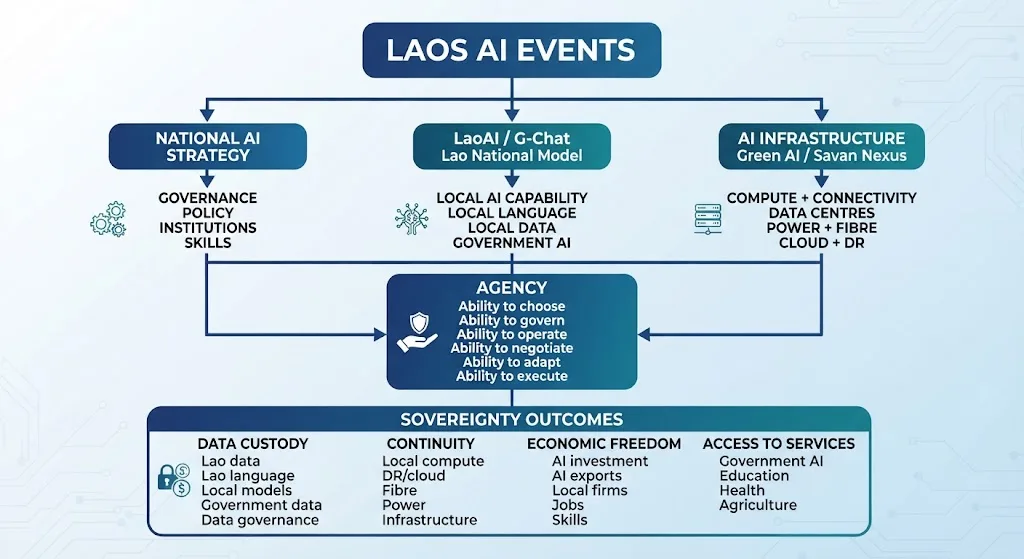
To see whether these pieces reinforce one another, it helps to read each initiative against five factors: Agency (skills, institutions, governance — the ability to make choices), and the four things that capability buys — Data Custody, Continuity, Economic Freedom and Access to Services. Agency acts as the multiplier; the others are outcomes. The point is not that Laos should own everything, but that it is building the capacity to choose.
| Laos AI initiative | Agency | Data custody | Continuity | Economic freedom | Access to services |
|---|---|---|---|---|---|
| National AI Strategy | ↑↑ | ↑ | ↑ | ↑ | ↑ |
| LaoAI / Lao-language AI | ↑ | ↑↑ | ↑ | ↑ | ↑↑ |
| G-Chat + LaoAI | ↑↑ | ↑↑ | ↑ | → | ↑↑ |
| AI skills / training | ↑↑ | ↑ | ↑ | ↑↑ | ↑ |
| AI-ready data centres | ↑ | ↑ | ↑↑ | ↑↑ | → |
| Green AI / energy strategy | ↑ | → | ↑↑ | ↑↑ | → |
| AI-SEZ / Savan Nexus | ↑ | → | ↑ | ↑↑ | → |
| International AI partnerships | ↑↑ | →/↓ | ↑ | ↑↑ | ↑ |
| AI governance / UNESCO work | ↑↑ | ↑ | ↑ | ↑ | ↑ |
Two observations. First, most initiatives support several factors at once, which is consistent with an emerging national programme rather than isolated projects — though whether they become an integrated implementation plan depends on publication of the final strategy, funding, institutional mandates and execution milestones. Second, skills and institutions — Agency — appear repeatedly as the factor the strategy itself treats as the foundation, and it is exactly where the government's own September 2026 revision instructions concentrate: personnel, institutions, databases and clear priority uses.
What is already running — and what is still a plan
It is worth separating what exists today from what is proposed, because AI announcements are easy to over-read. The table below is our best current assessment.
| Initiative | Status | What it is |
|---|---|---|
| LaoAI (system + app) | Publicly launched / early deployment | A Lao government-facing AI system with a public mobile app; Lao, Chinese and English |
| G-Chat v2 + LaoAI | Publicly launched / early deployment | Government communication platform with AI assistance for civil servants |
| Lao-language data programme | Active | Workshops and cooperation to build high-quality Lao-language datasets |
| AI governance programme | Active | UNESCO readiness work and AI Singapore/NUS engagement |
| China–Laos AI cooperation centre | Active | Cooperation platform for training, applications and language technology |
| Invest-in-Laos AI/OCR platform | Active | AI-assisted investment processing |
| Savan Nexus AI & Digital Campus | Feasibility | Proposed ~2 MW initial AI-ready Tier III campus in Savan Park, Savannakhet (reported specifications; feasibility stage) |
| Vientiane AI-SEZ / Green AI | Feasibility | Study for green-powered AI infrastructure and an SEZ over 150 hectares |
| ~1 GW Green AI data centre | Proposed concept | A large clean-energy AI infrastructure ambition under study |
| ASEAN Digital and AI Hub (Menas Capital) | MoU | Framework agreement; scope, site and funding not publicly detailed |
| National Health AI Platform | Feasibility | Study for AI in public health and medical records |
This is a normal and healthy picture for a country at this stage: strong capability and governance work already running, with the large physical infrastructure in the study and investment-attraction phase. The distinction matters mainly because installed megawatts and signed MoUs are often reported as though they were the same thing. In Laos' case, the practical test over the next year is how many of the feasibility projects advance to construction and operation.
Two caveats on the "publicly launched / early deployment" label. First, for LaoAI and G-Chat v2 it means publicly launched and demonstrated for government use; the extent of routine, production use across ministries and provinces has not been independently quantified, and the public record does not establish LaoAI's model ownership, data-residency or security arrangements — it is best described as a government productivity and digital-administration tool rather than a proven sovereign model. Second, "strategy" throughout this article means a draft approved in principle, not adopted law.
Who is helping Laos build AI
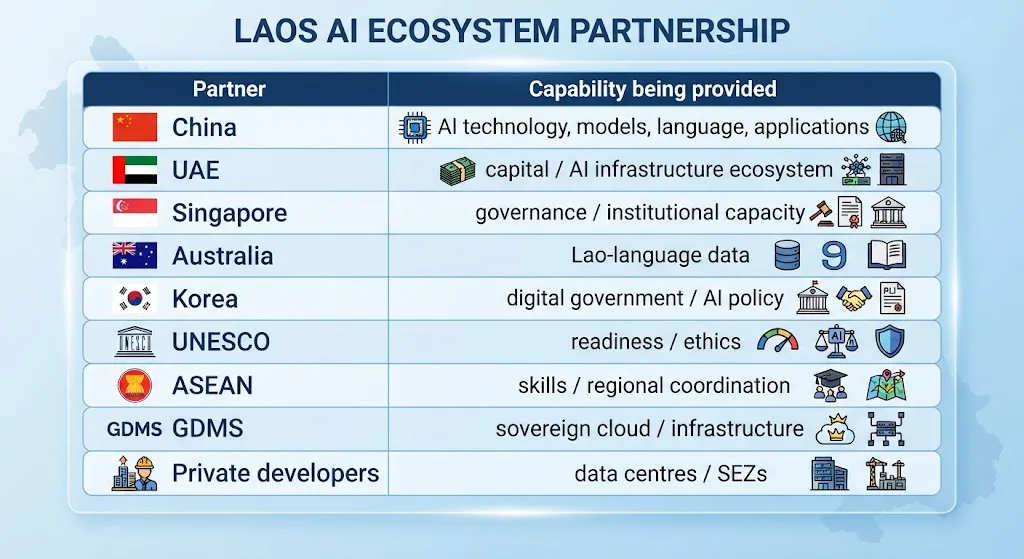
One of the more distinctive features of Laos' approach is that it works with several international partners rather than relying on a single technology bloc. Each partner contributes a different layer.
| Partner | Main contribution |
|---|---|
| China / Guangxi | AI models, Lao-language technology, applications, cooperation platform |
| UAE / G42 ecosystem | AI infrastructure, data-centre interest and investment (G42 discussions; Menas Capital MoU) |
| Singapore / AI Singapore | AI governance and institutional capacity |
| UNESCO | AI readiness, ethics and governance framework |
| Australia | High-quality Lao-language data and AI capacity |
| Korea | AI policy and digital-government experience |
| ASEAN Foundation | Skills and regional AI capacity building |
| GDMS | Domestic sovereign cloud and data-centre infrastructure |
| Private developers | Data centres, special economic zones and campuses (e.g. Silicon Tech Park, Savan Nexus) |
The Savan Nexus signing also drew infrastructure vendors — Comin Asia and Nokia were present, with Nokia presenting on AI and digital infrastructure. Vendor participation signals commercial interest in the project, but it is not a financial commitment.
This diversified partnership portfolio may reduce reliance on any single external technology provider — a reading of the portfolio's shape, not a stated government doctrine. Working across several partners lets Laos assemble capability without formal alignment to a single provider. In a small economy, that breadth of options is itself a form of strategic capability.
The green-compute idea: turning electricity into digital exports
The most economically interesting part of the strategy is the attempt to link Laos' energy position to computing. The country already produces large amounts of hydropower and is developing wind and solar; the idea is to use some of that clean electricity to power data centres and AI workloads, and to sell the resulting compute, cloud and digital services rather than only exporting power.
The proposed ~1 GW "Lao Green AI Data Center" concept and the AI special economic zone are the clearest statements of this ambition, and Savan Nexus — with renewable energy among its proposed components — is the first project to put it in a specific location. On the ~1 GW figure specifically: it is reported by MTC as a preliminary concept — no public financing, site allocation, power-purchase agreement, grid interconnection, construction procurement or customer commitment has been identified. If it works, it would address a long-standing question for Laos: how to capture more value from its energy resources. The practical requirements — reliable grid capacity, power agreements, fibre routes, cooling, and customers — are substantial, which is why the projects are being studied carefully before construction.
Put plainly: Laos is exploring green-energy-powered AI infrastructure — including an AI Innovation Center pilot and a proposed AI-focused special economic zone in Vientiane — and is seeking investment in data centres and AI. It has not built or commissioned green AI data centres, and it is not yet a green-compute hub. The 2025 MoU and feasibility study are real; an operating site is not.
Hydropower may create an opportunity for lower-carbon AI compute, but that is a project-level claim rather than a national guarantee. Confirming it would require the facility's power contract, grid mix, backup generation, cooling and water use, and any renewable-energy accounting.
How we checked this
This article is based on publicly available official and media sources: the Ministry of Technology and Communications (MTC/MOTC) and Ministry of Post and Telecommunications (MPT) announcements (including Lao-language material), KPL, Vientiane Times, Invest Laos, UNESCO, the NUS/AI Singapore governance roundtable report, ISEAS, and major regional media. Sources are linked inline throughout the timeline and listed below. Unless stated otherwise, dates reflect the first public announcement of an item. Where a claim is a proposal or study rather than an implemented fact, we say so explicitly.
What we could not verify
Some widely repeated claims are not yet supported by public documentation, and we have not presented them as fact:
- The full text of the National AI Strategy 2026–2035, its budget, responsible-agency matrix and KPIs — approved in principle, not yet published.
- Any committed large GPU deployment, hyperscaler tenant, or confirmed power-purchase agreement specific to AI workloads.
- The detailed scope, site, funding and equity of the ASEAN Digital and AI Hub associated with Menas Capital.
- Any direct link between a specific southern Laos wind project and an AI data centre; renewable energy is a stated component, but the connection is not yet documented.
- The technical and governance specifics of LaoAI: model ownership and IP rights; whether the core model is trained domestically, fine-tuned, licensed or API-backed; training-corpus governance and consent; data-residency and cross-border inference; cybersecurity assurance, red teaming and independent benchmarking; access rules for government and private users; and privacy, retention and audit controls.
- Any dedicated Lao AI law, standalone AI regulator or AI-specific rules; the strategy is a draft approved in principle, and no binding AI regulation has been identified.
These are open questions, not conclusions. They are also the items most worth watching.
What to watch in 2027
The next twelve months will show whether the strategy moves from announcement to operation. The most informative signals will be:
- The final National AI Strategy, with a funded implementation plan, lead agency, milestones and measurement.
- GPU and compute procurement — concrete numbers of accelerators actually installed in Laos.
- Power commitments — megawatts allocated, power-purchase agreements, grid connections and renewable sources.
- First commercial AI tenants — companies signing real capacity agreements, not just expressing interest.
- Savan Nexus progress — feasibility → land allocation → power agreement → financing → construction.
- Government AI workloads — how many ministries use LaoAI in daily work, and for what.
- Talent and institutions — university programmes, AI training numbers and research capacity, which the strategy itself identifies as foundational.
Laos has assembled the components of a national AI strategy faster than most observers expected from a country of its size. The direction is visible — local-language AI, government applications, governance, domestic infrastructure ambitions and proposed green-powered compute. What remains is execution: turning feasibility studies into operating capacity, and capability into lasting institutions. That is the story to follow.
Sources and further reading
The primary and official sources behind the milestones in this article:
- Government of Laos: Ministry of Technology and Communications (MTC) · Ministry of Post and Telecommunications (MPT) · Lao News Agency (KPL) · Invest Laos
- Key announcements: National Data Center × Silicon Tech Park green-AI MoU (2025) · Vientiane Times on the green-AI feasibility MoU · PM sets 2026 as a decisive year, directs an AI Data Centre (Jan 2026) · G-Chat v2 + LaoAI (Apr 2026) · MTC on the AI-SEZ / Green AI study · Cabinet advances the National AI Strategy (Sep 2026) (Vientiane Times; KPL) · Savan Nexus AI & Digital Campus (Sep 2026) (LNCCI)
- Independent assessments: UNESCO AI Readiness Assessment · AI Singapore / NUS AI Governance Roundtable (Vientiane) · China–Laos AI Innovation Cooperation Centre (SASAC) · ISEAS on Beijing's AI outreach · Straits AI — State of Applied AI: Laos
- Media: Vientiane Times · The Star
Frequently asked questions
What is the Laos National AI Strategy 2026–2035? +
It is a draft ten-year national strategy for artificial intelligence, developed with guidance from UNESCO's AI Readiness Assessment. The Cabinet approved it in principle on 22–24 September 2026 and asked the Ministry of Technology and Communications and relevant agencies to revise the draft before final adoption. As of October 2026 the full text has not been published, no dedicated AI law or standalone AI regulator has been identified, and the measures are therefore not yet enforceable policy. (Sources: Cabinet decision, September 2026 — KPL, Vientiane Times, Asia News Network; UNESCO AI Readiness Assessment.)
What is LaoAI? +
LaoAI is a Lao national AI system and mobile app, presented publicly in November 2025 (a gift to the Lao people for the 50th anniversary of the Lao PDR) and integrated into the government platform G-Chat v2 in April 2026. Public descriptions support a government productivity and digital-administration tool — document summarisation, drafting, translation and regulatory knowledge — in Lao, Chinese and English. Public documentation does not establish the model's ownership, whether it is trained domestically or licensed, or its data and security arrangements, so it should not be described as a proven sovereign foundation model. (Sources: MPT, November 2025; KPL, April 2026; App Store listing.)
Does Laos have its own large language model? +
Laos has been developing a Lao National Large Language Model. ALO Technology Group and the China-Laos Information Communication Centre announced work on it in October 2025, and partners have reported a model capable of Lao–Chinese–English translation. It is best understood as a Lao-language and government-services capability rather than an attempt to compete with frontier models like GPT or DeepSeek. Public sources do not yet show whether the core model is trained domestically, fine-tuned, licensed or API-backed. (Sources: The Star, October 2025; ISEAS.)
What is the Savan Nexus AI and Digital Campus? +
It is an AI-ready data centre and digital campus proposed for Zone C of the Savannakhet Special Economic Zone (Savan Park). An MoU signed on 25 September 2026 covers a feasibility study for roughly 20 hectares with an initial 2 MW AI-ready, Tier III facility, a carrier-neutral Meet-Me Room, international fibre, cloud, high-performance computing, disaster recovery and renewable energy. It is at feasibility stage. (Sources: Vientiane Times; LNCCI, 25 September 2026.)
Where are Laos' AI data centres? +
Two locations are publicly discussed. In Vientiane, an MoU signed in mid-2025 covers a feasibility study for green-energy-powered AI infrastructure and an AI special economic zone of more than 150 hectares. In Savannakhet, the Savan Nexus project is proposed inside the existing Savan Park SEZ. Both are feasibility-stage; no large AI data centre is confirmed as built and operating. (Sources: KPL; Vientiane Times.)
Is the 1 GW Green AI data centre in Laos actually committed? +
No. The roughly 1 GW 'Lao Green AI Data Center' is a proposed concept described by the Ministry of Technology and Communications, with feasibility work reported since May 2025. It is an ambition under study, not committed or constructed capacity. It should not be read as an operating 1 gigawatt facility. (Source: MTC, May 2026.)
Who are Laos' AI partners? +
Laos works with several partners on different layers: China (models, language technology, applications), the UAE (investment and data-centre interest via G42 discussions and a Menas Capital MoU), Singapore (governance), UNESCO (ethics and readiness), Australia (Lao-language data), Korea (policy and digital government), and the ASEAN Foundation (skills). The portfolio spans many countries and institutions, which may reduce reliance on any single external technology provider — an interpretation, not a stated doctrine. (Sources: KPL; MTC; Invest Laos.)
Is Laos a member of the World AI Cooperation Organisation (WAICO)? +
Laos consulted in June 2026 on China's invitation to join the proposed World AI Cooperation Organisation (WAICO). Later Lao government material describes the country as a prospective or founding participant, emphasising technology exchange, capacity building and safe, responsible AI. WAICO's formal status and any founding instrument are not yet public, so this should be read as a prospective role rather than confirmed membership. (Sources: KPL; MTC, June 2026.)