Plain of Jars, Phonsavanh: Sites, Safety, Getting There and Where to Stay
Published
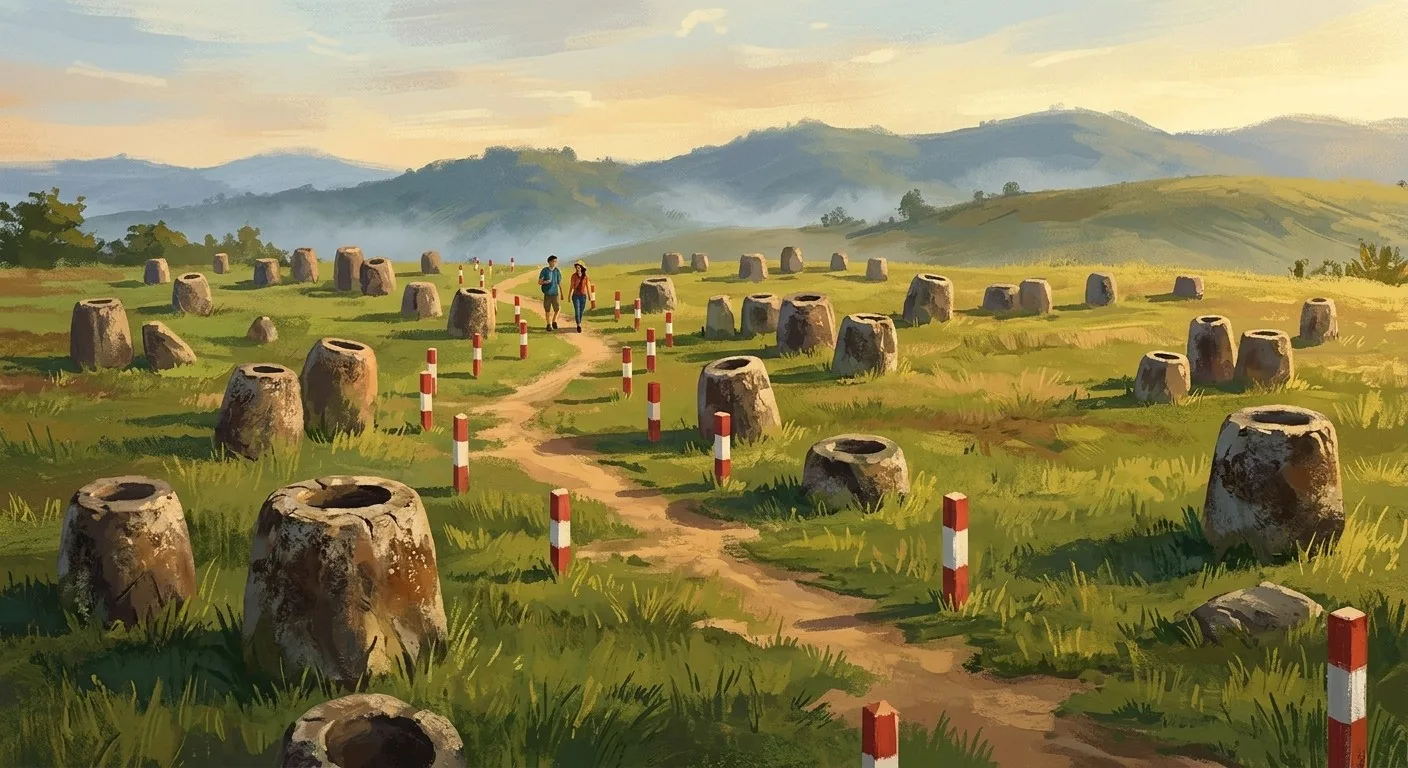
Short answer: the Plain of Jars is a UNESCO World Heritage Site (since 2019) scattered across Laos's Xiangkhoang Plateau: thousands of stone jars, some over 2,500 years old, whose original purpose is still debated. Only a handful of sites near the town of Phonsavanh are cleared of unexploded ordnance and open to visitors — Sites 1, 2 and 3, plus the Quarry — and you reach them by flying or driving to Phonsavanh first. This page covers what's actually there, which sites you can visit, and how to get there and back safely.
What the Plain of Jars actually is
The jars are carved from sandstone, granite, conglomerate, limestone or breccia, stand roughly 1 to 3 meters tall, and are spread across the Xiangkhoang Plateau in northeastern Laos. Dating work puts the earliest jars in place as far back as 1240 to 660 BC. (Wikipedia, citing published archaeological surveys)
The leading theory connects the jars to burial practice: some have been found to contain cremated human remains, and later secondary burials at jar sites have been dated to the 8th-13th centuries CE. Other researchers have proposed the jars served a role in mortuary ritual itself, functioning as distilling vessels, drawing a parallel to practices recorded elsewhere in Southeast Asian royal burial customs. No single explanation is settled, which is a real part of the site's appeal rather than a gap to paper over. (Wikipedia, citing published archaeological surveys)
UNESCO inscribed the Plain of Jars as a World Heritage Site in 2019, at its 43rd session. The listed property officially recognizes more than 50 jar sites, while surveys across Xiangkhoang province have now confirmed upward of 120 sites in total. (Wikipedia, citing published archaeological surveys)
Which sites you can actually visit
Almost all of those 50-plus sites remain closed to the public, for the same reason the area made national headlines decades earlier: they haven't been cleared of unexploded ordnance left over from the Second Indochina War bombing campaign. We've covered the national clearance numbers in detail in our guide to UXO in Laos — the short version is that Xiangkhoang province was among the most heavily bombed in the country.
The Mines Advisory Group (MAG) began clearance work at the Plain of Jars in 2004, in partnership with UNESCO and with funding from New Zealand. At Site 1 alone, MAG's own clearance records show 127 pieces of UXO removed and destroyed, 6 acres fully cleared, 55 acres visually searched, and 31,814 pieces of scrap metal recovered. That work opened four additional jar sites to visitors by 2007. (Wikipedia, citing MAG clearance data)
Today, Sites 1, 2 and 3, plus the Quarry, are the ones that are surface-cleared, marked, and open to visitors — each roughly a 45-minute drive from Phonsavanh. Site 1 is the largest and most visited, with over 300 jars including the biggest one on record. Sites 2 and 3 see far fewer visitors and sit across quieter farmland and forest.
Staying safe on site
The cleared sites have walkways laid out between clearly placed red-and-white markers. The rule is the same one that applies across rural Laos generally: stay on the marked path, between the markers, and never touch a metal object you find — see our full guide to UXO risk and precautions in Laos for the national context. Independent wandering off the cleared routes at any jar site is not worth the risk, however tempting an unusual-looking jar in the distance might be.
Getting to Phonsavanh
Phonsavanh is the provincial capital of Xiangkhoang and the base for visiting the jar sites. Lao Airlines and Lao Skyway operate flights between Vientiane and Phonsavanh's XKH airport, with a flight time of around 40 minutes — this is a seasonal route, so check current frequency directly with the airline before booking rather than assuming a daily schedule year-round.
Overland, regular vans and sleeper buses connect Phonsavanh with Vientiane and Luang Prabang. From Luang Prabang, day vans take around 7 to 9 hours (roughly $16-21), with a night sleeper bus option around 8.5 hours for about $23. From Vientiane, the journey is longer at around 12 hours by van or sleeper bus, from roughly $21-23. (12Go, fares checked November 2026, confirm current pricing and schedule before booking) Operators on these routes include Chitpasong Bus, Vieng Chaleune and several Luang Prabang-based travel agencies; book through a local agency or guesthouse in either city rather than assuming a fixed daily departure. Many travelers choose the road option deliberately for the mountain scenery along the way, rather than as a fallback from flying.
Where to stay in Phonsavanh
Most visitors base themselves in or near the town center, along Route 7 and its side streets, where the hotel and guesthouse choice is widest and everything — the morning market, restaurants, tour operators for the jar sites — is within walking distance. (12Go)
For a comfortable mid-range stay, Anoulackkhenlao Hotel and Vansana Plain of Jars Hotel are the two names that come up most consistently in traveler recommendations, both offering breakfast and some rooms with mountain-view balconies. On a budget, Sipanya Guesthouse and Jennida 2 are commonly recommended, with free Wi-Fi and basic amenities typical across the town's guesthouses. (12Go)
Best time to go, and how long to spend
October through February is generally considered the best window, avoiding both the wet season's mud and the hottest months. Plan on two to three hours if you're focused on seeing the jars at Sites 1, 2 and 3 — one night in Phonsavanh is enough. Stay a second night if you want to add the MAG information centre, the Xiangkhoang History Museum, or a half-day trip 35km southeast to Muang Khoun, the old royal capital largely destroyed by bombing, where the ruined Wat Phia Wat temple and its old Buddha statue still stand. (Rough Guides)
Frequently asked questions
Is the Plain of Jars worth visiting? +
Yes, for travelers interested in history rather than scenery alone. It's a genuinely unusual site: thousands of stone jars up to 3 meters tall, some over 2,500 years old, with no settled explanation for why they're there. It became a UNESCO World Heritage Site in 2019.
Which Plain of Jars sites can tourists actually visit? +
Sites 1, 2 and 3, plus the Quarry, are the ones cleared and open to the public — each within about a 45-minute drive of Phonsavanh. The wider area has over 50 recognized jar sites and more than 120 surveyed across Xiangkhoang province, but almost all of those remain closed because they haven't been cleared of unexploded ordnance.
Is the Plain of Jars safe from unexploded ordnance? +
The three open sites and the Quarry were surface-cleared and marked by the Mines Advisory Group (MAG), with walkways between clearly placed markers. Stay on the marked path and between the markers; never step off it or touch anything metal, on this site or anywhere else in rural Laos.
How do you get to Phonsavanh? +
Lao Airlines and Lao Skyway fly Vientiane to Phonsavanh (XKH airport) in about 40 minutes, though the route runs a seasonal schedule, so check current frequency before booking. Overland, vans and sleeper buses run from Vientiane (around 12 hours, from roughly $21-23) and from Luang Prabang (7-9 hours by van, from roughly $16-21, or a night sleeper bus around $23).
Where should you stay in Phonsavanh? +
Most travelers base themselves along or near Route 7 in the town center, where the hotel and guesthouse choice is widest. Anoulackkhenlao Hotel and Vansana Plain of Jars Hotel are the two names that come up most often for a comfortable mid-range stay; Sipanya Guesthouse and Jennida 2 are commonly recommended budget options.
How old are the jars, and what were they for? +
Dating puts the earliest jars in place as far back as 1240 to 660 BC. The leading theory is a burial function: some jars have been found to contain cremated remains, with later secondary burials dated to the 8th-13th centuries CE. Other researchers have proposed a role in mortuary rituals, such as distilling vessels, similar to practices recorded elsewhere in Southeast Asian royal burial customs. No theory is universally agreed.
How much time do you need at the Plain of Jars? +
Two to three hours covers Sites 1, 2 and 3 if you're mainly there to see the jars. Visitors with a deeper interest in the archaeology or the UXO clearance history often spend half a day, adding the MAG information centre in Phonsavanh and the Xiangkhoang History Museum.