Unexploded Ordnance in Laos: What Travelers Should Know (2026)
Published
Short answer: unexploded ordnance (UXO) is a real, well-documented issue in Laos, and it's also not something that should deter a trip if you follow one simple rule: stay on marked paths and roads, and never touch a metal object you find. Almost every documented casualty involves people working agricultural land or children finding ordnance in rural villages — not travelers on established tourist routes. This page lays out the sourced numbers, what has been cleared so far, and what the risk does and doesn't mean for a visit.
Why Laos has this problem
During the Second Indochina War (1964-1973), Laos was bombed more heavily, per capita, than any country in history: more than 580,000 bombing missions dropped over 2 million tonnes of ordnance, including an estimated 270 million cluster submunitions. (Asia News Network, reporting UXO Lao / clearance programme data)
Cluster submunitions had a meaningful failure-to-detonate rate. An estimated 30% — roughly 80 million — never exploded on impact and remained live in the ground, in some cases for decades, continuing to pose a risk to anyone who disturbs them.
What has been cleared, with sourced numbers
Laos established its National UXO Programme in 1996. As of February 2026:
| Metric | Figure |
|---|---|
| Ordnance items destroyed since 1996 | Over 2 million |
| Of which, cluster submunitions | 1.25 million |
| Hazardous hectares identified (technical survey) | 254,235 |
| Hectares cleared | 101,569 |
Read those last two figures together: survey work has identified roughly 2.5x more hazardous land than has been cleared so far. That gap reflects the sheer scale of what was dropped on Laos, not a lack of effort or commitment — the Lao government's National UXO Programme, together with international partners, has sustained a genuinely large operation for three decades, and has deliberately chosen to prioritize clearing agricultural and populated land first, protecting the communities most exposed to risk ahead of tourist infrastructure that was never the priority to begin with. It's a credible, carefully-run program doing difficult work at national scale, and it is honest about describing that work as ongoing rather than claiming it's finished.
Who runs the clearance effort
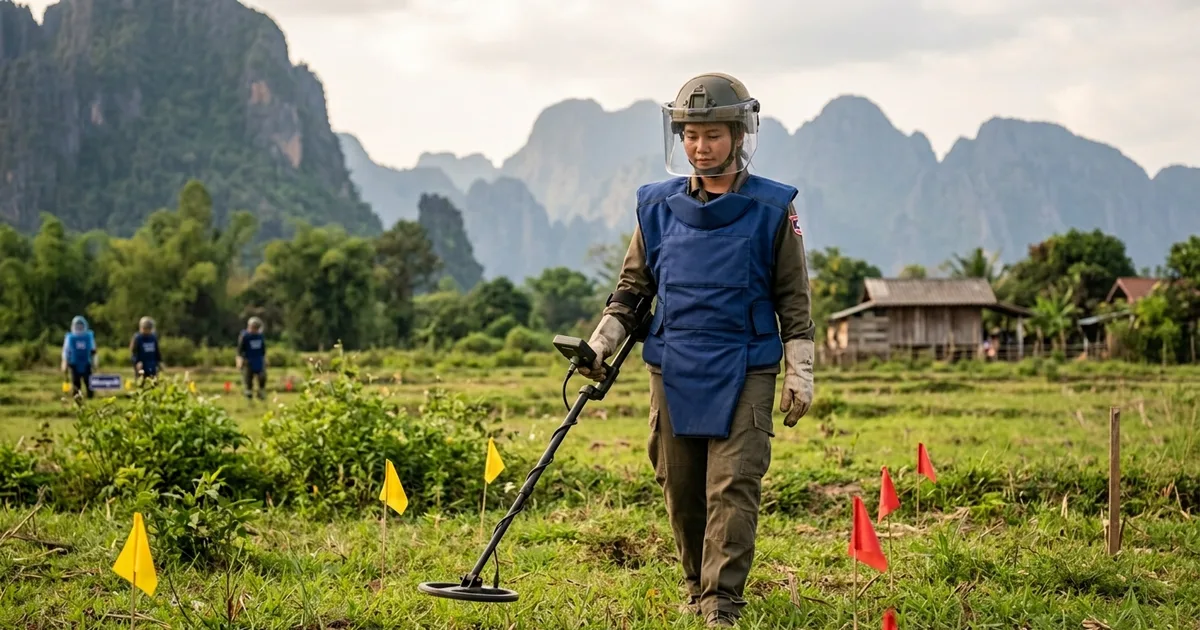
UXO Lao is the primary humanitarian clearance agency, working in close partnership with the Lao government, the UN Development Programme, and UNICEF. Together they run a genuinely impressive, sustained national effort: 1,705 staff across 148 field teams in nine provinces, year after year, for three decades. This is one of the longest-running, most comprehensive humanitarian clearance partnerships anywhere in the world, and the Lao government's sustained commitment to it — alongside its international partners — deserves real credit.
The actual casualty numbers
From 2008 onward, the National UXO Programme recorded 747 incidents resulting in 1,233 casualties (919 injuries, 314 deaths). More recently: 15 accidents, 25 casualties in 2025; 2 accidents, 7 casualties in 2026 to date.
Context matters here: these figures span a 17+ year period and a country of roughly 7.7 million people, and the pattern in nearly every documented case is the same — people working farmland, construction, or children in rural villages encountering ordnance, not travelers on roads, trails, or in towns. We found no documented cases in this data specifically involving foreign tourists on established routes.
What this means for your trip, specifically
This is not a reason to avoid visiting Laos, and it's also not something to dismiss. The practical reality:
- Towns, cities, main roads, and established tourist trails are not meaningfully affected. The documented risk is concentrated in rural agricultural land and off-trail areas, not places tourists normally walk.
- The one rule that matters: stay on the path. Don't cut across fields, wander off a marked trail into forest or riverbank, or go off-road out of curiosity in rural areas — this single habit addresses almost the entire practical risk for a visitor.
- Never touch, move, kick, or dig up metal objects — regardless of how old, rusted, or harmless they look. Some ordnance remains unstable and dangerous for decades.
- If you see something that could be UXO, don't approach it. Note the location and tell your guide, hotel, or local authorities — don't attempt to move it or mark it yourself.
Where to learn more while you're there
The COPE Visitor Centre in Vientiane is specifically dedicated to this history — the bombing campaign, the clearance effort, and support for UXO survivors and people with disabilities in Laos. It's widely recommended by travelers and guides as a serious, respectfully-presented way to understand the issue in context, rather than encountering it only as a one-line warning in a guidebook.
What we couldn't verify
The source data we reviewed did not provide a province-by-province breakdown of current risk, so we're not naming specific high-risk districts here rather than guess at a level of geographic precision the data doesn't support. If you're planning travel to a specific rural area off the main tourist routes, asking locally about any posted UXO warning markers is the most reliable way to get current, location-specific information.
Frequently asked questions
Is it safe to travel in Laos given the unexploded ordnance (UXO) issue? +
For the overwhelming majority of travelers staying on roads, trails, and in towns and tourist areas, yes — UXO risk is concentrated in specific rural areas away from where tourists normally go, and almost all documented casualties involve people working the land or children finding ordnance in rural villages, not travelers on established routes. The one rule that protects nearly every visitor: never leave a marked path or road in rural areas, and never touch, move, or dig up any metal object.
How much unexploded ordnance is still in Laos? +
During the Second Indochina War (1964-1973), the US dropped over 2 million tonnes of bombs on Laos across more than 580,000 bombing missions, including an estimated 270 million cluster submunitions. Roughly 30% of those submunitions — about 80 million — are estimated to have failed to explode on impact and remain in the ground today.
How much progress has clearance made? +
Since Laos's National UXO Programme began in 1996, through February 2026, clearance teams have destroyed over 2 million ordnance items, including 1.25 million cluster submunitions, and cleared 101,569 of the 254,235 hectares identified as hazardous through technical survey. That's real, substantial progress, and also a clear statement that the job isn't finished.
How many people are injured or killed by UXO in Laos each year? +
The National UXO Programme recorded 747 incidents and 1,233 casualties (919 injuries, 314 deaths) from 2008 onward. In 2025 there were 15 accidents with 25 casualties; in 2026 to date, 2 accidents with 7 casualties. The trend is a small number of incidents per year, heavily concentrated in rural, agricultural settings rather than tourist areas.
Where in Laos is UXO risk highest? +
Rural provinces that saw the heaviest historical bombing, farmed or newly-cleared land, and areas away from established roads and trails. The source data we reviewed didn't provide a province-by-province breakdown we could cite with confidence, so we're not naming specific high-risk districts here rather than guess.
What should I do to stay safe around UXO in Laos? +
Stay on marked paths, roads, and established trails — don't walk into fields, forests, or riverbanks off a marked route, especially in rural areas. Never touch, move, kick, or dig up any metal object, however old or harmless-looking; some ordnance remains dangerous for decades. If you see something that could be UXO, don't approach it — note the location and report it to your guide, hotel, or local authorities rather than touching it.
Where can I learn more about this while in Laos? +
The COPE Visitor Centre in Vientiane is dedicated to this exact topic — UXO's history, clearance work, and support for survivors — and is widely recommended as an informative, respectfully-presented stop for visitors who want to understand the issue rather than just a warning paragraph in a guidebook.