Mobile Coverage & Internet on the Laos-China Railway (2026)

Short answer: you can use mobile data on the Laos-China Railway, but do not expect it to stay connected. 4G is generally usable around the main stations and in open areas, and it drops out repeatedly in the mountains — above all between Vang Vieng and Luang Prabang — because roughly half the Lao route runs through tunnels. There is no reliable passenger Wi-Fi to fall back on. In June 2026, Lao Telecom and the railway signed a deal to build a dedicated 4G network along the corridor, but phase one only targets about 64% of open areas by the end of 2026, excluding tunnels. Download everything you need before you board.
Last checked: October 2026. Coverage on the Lao section is actively changing with the Lao Telecom build-out, so treat this as a 2026 snapshot and verify conditions on the day.
Is there Wi-Fi on the Laos-China Railway?
No. On the Lao section (Boten–Vientiane), there is no documented passenger Wi-Fi service — not onboard and not at stations — in 2026. A 2025 traveller who spent around eight hours on the Kunming–Vientiane train reported "no Wi-Fi" and relied on mobile data instead, and 2026 railway guides say the same. A 2021 Huawei announcement about building a wireless network "along the line" refers to railway-area mobile infrastructure, not in-train passenger Wi-Fi, and should not be read as a Wi-Fi service.
The practical consequence: the only connectivity you have is your phone's mobile data, which behaves very differently at a station than in a tunnel.
What mobile coverage to expect in 2026
The pattern is consistent across official sources and traveller reports:
| Where | Coverage | Reliability |
|---|---|---|
| Major stations (Vientiane, Vang Vieng, Luang Prabang, Boten) | 4G generally available | Good |
| Open sections near towns | 4G usable | Good, then gaps |
| Tunnels (75 on the Lao route) | Signal lost | Repeated dead zones |
| Vang Vieng → Luang Prabang | Patchy | Weakest leg; ~30–45 min without signal reported |
| Chinese section (Yuxi–Mohan) | Full 4G, some 5G | Markedly better |
Why tunnels cause the dead zones
The Lao section runs roughly 422 km from Boten to Vientiane, and it is extraordinarily tunnelled: about 75 tunnels totalling roughly 198 km, plus around 167 bridges. That means close to 47% of the route is underground. No SIM can provide signal inside a tunnel unless the railway itself is wired for it — and the official 2026 build-out explicitly excludes tunnels from its first-phase target.
So when your phone loses signal mid-journey, it is usually not a problem with your SIM or handset. The train has simply entered a tunnel. Signal normally returns after the train emerges.
The 2026 Lao Telecom 4G project
The most important change on the horizon is the 11 June 2026 agreement between Lao Telecommunication Public Company and Laos-China Railway Company Limited, independently reported by Developing Telecoms and The Star. Lao Telecom is leasing railway infrastructure — base stations, fibre-optic cable and related equipment — to build and operate a dedicated 4G mobile network along the 224 km Vientiane (Nakhae)–Luang Prabang corridor. The stated purpose includes improving connectivity for passengers onboard trains and at stations, with a minimum user speed target of 3 Mbps and reported investment of more than US$8 million.
| Phase | Timing | Target | Important caveat |
|---|---|---|---|
| Phase 1 | by end-2026 | ~64% coverage | Excludes tunnels; is 64% of open areas, not 64% of the journey |
| Phase 2 | from early 2027 | ~90% of the Vientiane–Luang Prabang route | A future target, not current coverage |
A separate Chinese railway-technology report mentions a leaky-cable/antenna approach for tunnel sections, but the official Lao announcement does not currently promise tunnel coverage. Until that is confirmed and delivered, do not assume mobile service continues inside the tunnels.
Section by section
- Vientiane → Vang Vieng: the easiest leg. Terrain is flatter and 4G is generally available around towns; a 2026 Vang Vieng guide reports good coverage in the town itself.
- Vang Vieng → Luang Prabang: the problem stretch. The route turns mountainous and tunnel-heavy, and reports describe Unitel signal disappearing in the tunnels for roughly 30–45 minutes on this leg.
- Luang Prabang → Boten: thinner evidence, but still mountainous northern Laos — do not count on continuous data. Boten itself has connectivity.
- China side (Yuxi–Mohan): full 4G since around the 2021 opening, with some 5G. Travellers going Kunming → Vientiane often notice excellent connectivity in China and then a drop after crossing into Laos.
Which network should you use on the train?
There is no railway-specific measurement that proves one Lao operator is best on the train, so be sceptical of any page that claims "use Unitel and you'll have internet the whole way." What is defensible:
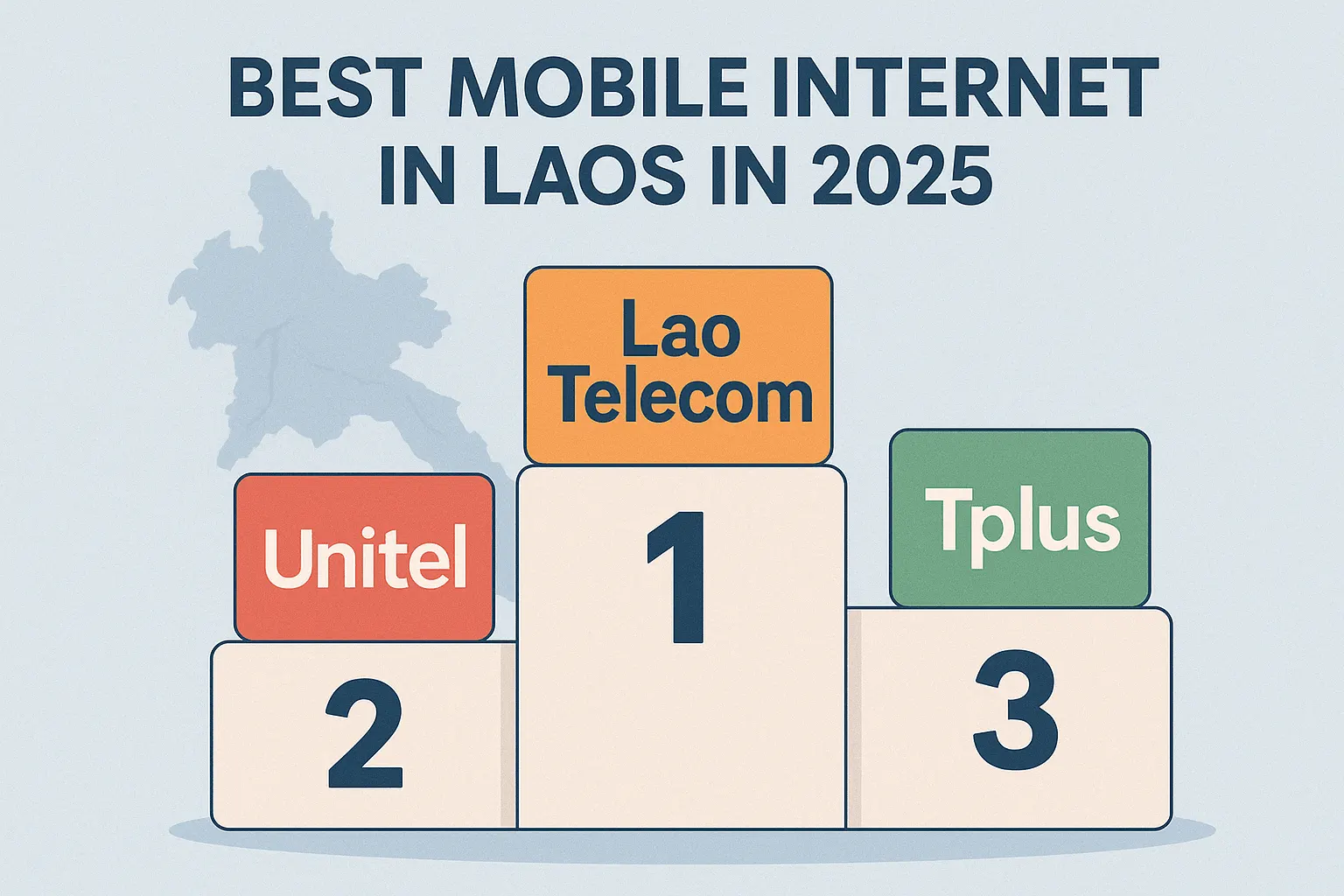
- Unitel has the broadest coverage reputation around Laos and is a sensible general choice for travel in the country (see our Unitel review).
- Lao Telecom is the operator building the dedicated railway 4G network, so it is becoming more relevant specifically for this corridor.
- Any major local network will work at stations and in open areas — and none of them will work inside a tunnel until tunnel coverage is actually built.
A local SIM or eSIM is cheaper and more practical than international roaming. See our guides to SIM cards in Laos and to choosing a local versus regional eSIM, and the Laos coverage map for the wider picture.
How to stay connected on the journey
The realistic strategy is to prepare offline and treat the ride as disconnected time. In order:
- Get a local SIM or eSIM before boarding — a major Lao network, set it up and test it at the station while you still have signal.
- Save your LCR ticket and hotel details offline. Screenshot the LCR ticket QR code and copy addresses, phone numbers and booking references into your notes. Boarding can depend on digital records you may not be able to load mid-journey.
- Download offline maps and entertainment — Vientiane, Vang Vieng and Luang Prabang, plus any audio, films or translation packs for the tunnels.
- Charge up and use low-power mode, switching it off only when you have signal. There are power outlets at the seats, but a power bank removes the worry.
- Message from the platform, not mid-ride, and do not schedule calls, remote work, video meetings or financial approvals for the journey.
What actually works when you have signal
| Activity | Expectation |
|---|---|
| WhatsApp / Messenger | Works when connected |
| Fine when signal is available | |
| Maps / navigation | Works, but use offline maps |
| LCR ticket QR | Save it before boarding |
| Streaming | Possible in good coverage, not dependable |
| Video calls / remote work | Do not rely on it |
| Cloud uploads / live navigation | Can fail in tunnels |
What we could not verify
There is a lot of copied misinformation about this route. We could not find primary evidence for claims such as "Unitel built dedicated towers along the whole railway", "the train has reliable onboard Wi-Fi that drops above 160 km/h", or "Lao Telecom already has 90% railway coverage". The 90% figure is a future project target, and the June 2026 build-out is being done by Lao Telecom, not Unitel. If you see those claims elsewhere, treat them as unconfirmed.
Related guides
- How to book Laos-China Railway tickets with the LCR app (2026)
- The China-Laos Railway: a success story in modern transport
- Internet providers in Laos compared (2026)
- Best SIM cards in Laos · Laos travel eSIM — data on arrival without hunting for a SIM shop.
Sources: Vientiane Times (June 2026 railway telecom expansion), KPL (Laos-China Railway project data), Developing Telecoms and Seetao (project and technical reporting), Huawei (2021 railway connectivity background), and 2024–2026 traveller reports on Reddit and in railway guides. Coverage targets are project plans and may change.
Frequently asked questions
Is there Wi-Fi on the Laos-China Railway train? +
No. No reliable passenger Wi-Fi is documented on the Lao section in 2026, either onboard or at stations. Plan to rely on mobile data, and treat the journey as largely offline.
Is there mobile coverage on the Laos-China Railway? +
Yes, but not continuously. 4G is generally usable at stations and in open areas near towns, and it drops frequently inside the railway's many tunnels. Coverage is improving, but do not expect a sustained connection for the whole trip.
Which section of the Laos-China Railway has the worst coverage? +
The mountainous stretch between Vang Vieng and Luang Prabang is the weakest. Traveller reports describe roughly 30–45 minutes without signal on that leg as the train passes through long tunnels. The Chinese side of the line is markedly better.
Which Lao network is best on the train — Unitel or Lao Telecom? +
There is no railway-specific measurement proving one is best. Unitel is the popular choice for broad coverage around Laos, while Lao Telecom is building and operating the dedicated 4G network for the railway corridor. Use a major local network, but don't pick one on the promise of continuous train coverage.
Is there 5G on the Laos-China Railway? +
The Chinese section has full 4G and some 5G availability. On the Lao section there is no confirmed passenger 5G service; the 2026 project is a 4G build-out targeting at least 3 Mbps per user.
When will coverage on the Laos-China Railway get better? +
Lao Telecom's project targets about 64% of open areas (tunnels excluded) by the end of 2026, then 90% of the Vientiane–Luang Prabang route from a second phase starting in early 2027. Those are targets, not delivered coverage.
Do I need a local SIM or eSIM for the train? +
A local SIM or eSIM is cheaper and more practical than international roaming, and it works at stations and in open sections. Neither can fix the tunnel dead zones, so download what you need before boarding regardless.
Can I show my LCR train ticket without internet? +
Yes — save the QR code screenshot before you leave, because the app may not load reliably mid-journey. Keep your passport with you as the booking ID.
Need mobile data sorted for your Laos trip? Our Laos eSIM runs on the local Unitel network, from $6.90.